
Electric car chargers in condominiums: new law in São Paulo exposes limits and conflicts.
The law guarantees installation in private parking spaces, but imposes technical rules and opens a new front for disputes between residents and condominiums.
The rise of electric mobility in Brazil has moved beyond the streets and into consumers' garages. And with that, it has opened a new front in the debate about rights, limits, and coexistence.
In São Paulo, State Law 18.403/2026 marks a watershed moment by guaranteeing that condominium residents can install charging points for electric vehicles in their private parking spaces. In practice, the law prevents condominiums from arbitrarily prohibiting installation – a move that repositions consumer rights within collective environments.
However, despite the progress, the law also reveals a more complex reality: the right exists, but it is not absolute, and its application can generate new conflicts.
Consumer rights in condominiums
From a consumer protection perspective, the new legislation can be interpreted as an extension of the right to choose. This is, in fact, one of the pillars of the Consumer Protection Code (CDC).
According to Gilberto Jabur, a professor of Civil Law at Faculdade Belavista, the rule represents an important step forward in this regard. "Law No. 18.403/2026 upholds the freedom of choice of..." consumer who chooses to buy, rent or use an electric motor vehicle Therefore, a charging point is needed at home. This is a protection of private autonomy, as it aims to prevent restrictions that would undermine the consumer's right to free choice.”
Along the same lines, lawyer Livia Paiva, partner at the law firm André Menescal Advogados, states that the law brings principles of the Consumer Protection Code into the reality of condominiums.
“"Law 18.403/2026 brings principles of the Consumer Protection Code closer to the reality of condominiums. It prevents the conservatism of condominium bylaws from hindering the technological transition of those who opt for sustainable mobility."”
Lawyers Ivan Kubala, lawyer specializing in Civil Litigation and Real Estate Law and partner at the law firm Mazzucco & Mello Advogados. and Nicoly Crepaldi Minchuerri, a lawyer specializing in Civil Law at the firm, They emphasize that the rule limits arbitrary decisions. "The law directly addresses freedom of choice and the prohibition of abusive practices, by limiting the condominium's power to generically prevent the installation of infrastructure essential to the use of the property."“
Conditions of the new rule
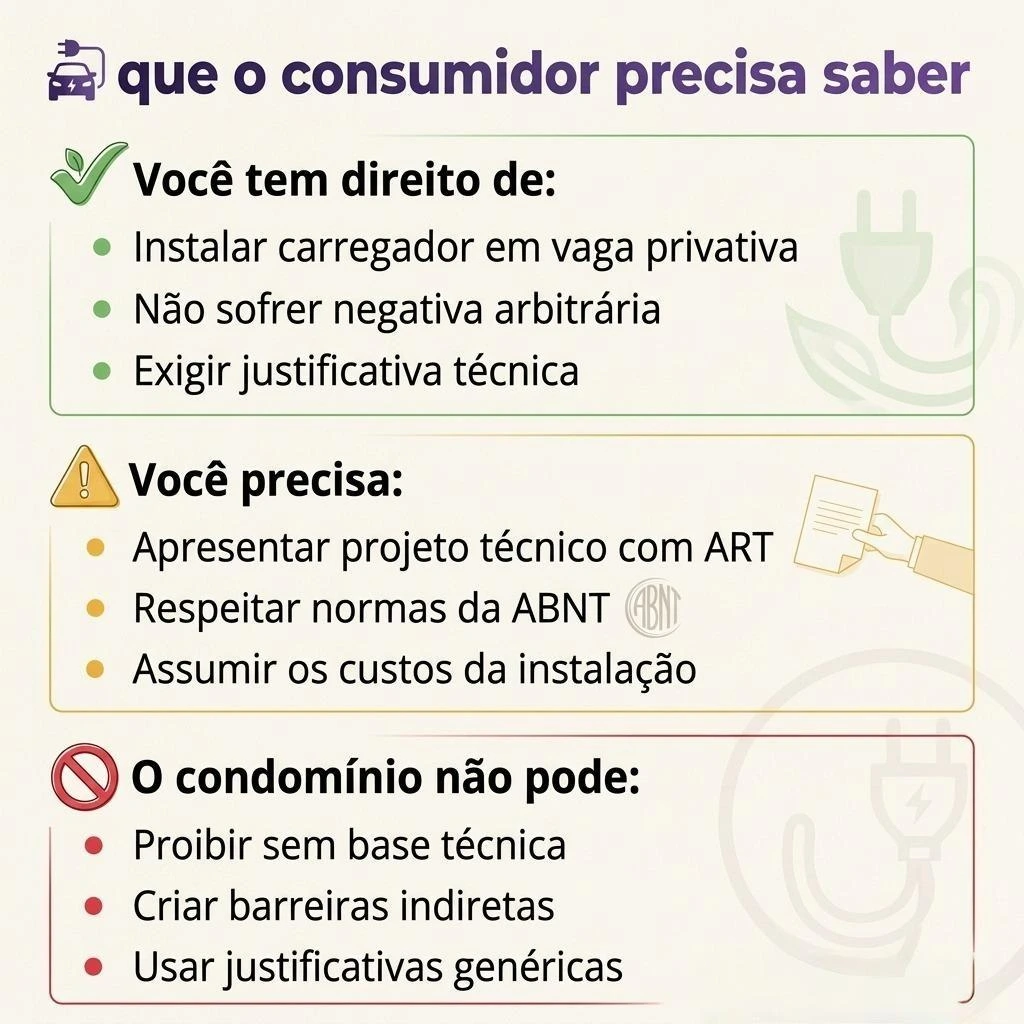
Although the law guarantees the right to installation, it imposes clear conditions. The condominium can still refuse, provided there is a proven technical basis.
According to Stefano Ribeiro Ferri, a specialist in Consumer Law and member of the OAB-SP (Brazilian Bar Association of São Paulo), this is the most sensitive point of the new legislation. “A valid technical justification needs to be concrete, verifiable, and proportionate. It is not enough to generically allege risk or lack of infrastructure. Without technical justification, the refusal tends to be considered unjustified.”
Still, he warns of the risk of distortions in practice.
“"It is not uncommon for technical requirements to be inflated or used as an indirect way to block changes. This may constitute an abuse of rights and a violation of good faith."”
In practice, what changes is the type of dispute. Before, a refusal was simple. Now, it needs to be technical, and this shifts the conflict to another field.
According to Professor Gilberto Jabur, the central point lies in the balance between individual rights and collective limits. “Individual consumption decisions can have impacts on third parties. Therefore, the legal system itself imposes limits on property rights, especially when there is a risk to the safety, health, or peace of other residents,” he explains.
In the case of electric vehicles, this impact is concrete. "The installation of chargers increases the load on the building's electrical system. Therefore, it is essential that technical solutions are adopted that guarantee safety and that the cost is borne exclusively by the user," he states.
From prohibition to justification
According to experts, the debate is no longer about "can it or can't it" and is now revolving around technical conditions, electrical capacity, and safety.
This scenario could even lead to an initial increase in litigation.
“Initially, there is likely to be an increase in conflicts and even litigation, because building managers and residents are still adapting to the new rule. Over time, the trend is towards greater predictability,” says Stefano Ferri.
This interpretation also appears in the legal analysis of real estate experts, who point out that the focus of disputes should shift to technical criteria and the feasibility of the installation.
Infrastructure is the main bottleneck.
While legal advancements may be occurring, in practice they encounter a concrete limitation: the electrical infrastructure.
Electrical engineer Andrey Bucko, a specialist in electrical infrastructure applied to electric mobility at Reymaster Materiais Elétricos, is straightforward:
“"Most Brazilian condominiums are not yet prepared to support individual charging points, especially older buildings."”
According to him, the risks are not trivial. “Without a proper design, there is a risk of overload, overheating of conductors, and even short circuits. Therefore, following technical standards and implementing protection systems is essential.”
Furthermore, the cost can vary significantly. “In some cases, the adaptation can be simple. In others, it may require reinforcing the power supply and modernizing the entire electrical infrastructure,” says Andrey. In practice, this means that the consumer's right to install charging points – even if recognized or under discussion – has a technical limit that requires collective planning and investment. In practice, the feasibility of the installation may require an analysis of the building's electrical capacity and, in some cases, adaptations involving the collective infrastructure.
Another sensitive point is load management. Without intelligent balancing systems, the installation of multiple chargers can compromise the building's overall power supply, affecting not only electric vehicle users but all residents.
This scenario highlights an important gray area between regulatory progress and technical feasibility. On one hand, there is growing pressure for electrification and sustainability; on the other, the existing infrastructure is not yet keeping pace.
The cost is individual, the impact is collective.
Another key point of the law is the definition of responsibility: the cost of installation falls to the resident.
However, the impacts are not only individual.
For Livia Paiva, this is the most evident point of tension: “The conflict arises when an individual decision puts pressure on a shared infrastructure. Individual rights cannot jeopardize collective assets.”
Gilberto Jabur reinforces that the legal system already provides limits in this type of situation.
“"THE exercise of property rights "It finds its limits whenever there is a repercussion on the safety, health, and peace of the other residents."”
Before the new legislation, the absence of specific rules on the subject generated legal uncertainty and divergent decisions between condominiums and residents. For Valdir Oliveira, a specialist in Real Estate Law, this scenario contributed to an increase in conflicts.
“"The installation of chargers was analyzed on a case-by-case basis, based on general principles of condominium law, which generated legal uncertainty and an increase in lawsuits."”
Given this new reality, the legislation establishes clear limits to prevent abuses and guide the relationship between residents and condominiums. But, in practice, what can the consumer do – and what can the condominium do – and what can't they do?
New consumer behavior
The new legislation also reveals an important shift in consumer behavior.
Today, sustainability is no longer just talk; it has begun to guide practical consumption decisions.
“"Contemporary consumer behavior shows a greater environmental concern, which is reflected in the choice of electric vehicles," says Gilberto Jabur.
For Livia Paiva, this movement is even more intense: "Today's consumer is proactive and doesn't wait for the building to modernize. They force modernization."“
This transforms the condominium into a space of constant tension. "The condominium is the perfect microcosm of consumer society, where individual innovation clashes with traditional structures," adds the lawyer.
São Paulo can influence the country.
By regulating the issue, São Paulo is anticipating a debate that is likely to gain momentum with the expansion of electric vehicles.
According to experts, the initiative could serve as a reference for other states and contribute to the development of future national legislation.
However, there are challenges. Experts Ivan Kubala and Nicoly Crepaldi Minchuerri They warn of potential legal challenges. "There is room for discussion regarding the constitutionality of the rule, since the Union has the power to legislate on Civil Law. This could drive the need for federal regulation. And, as the law directly impacts condominium relations, this point could be the subject of judicial debate," they explain.
In addition to legal issues, there are practical limitations that may generate insecurity. The law applies only to private parking spaces, which excludes a significant portion of condominiums – especially those with rotating parking systems. Added to this is the lack of more detailed regulations, increasing the uncertainty in the application of the rules.
Given this scenario, the discussion is likely to gain national scope – either through litigation or through the need to standardize criteria, bringing more legal certainty to consumers and condominiums.

A new right and a collective challenge.
Finally, and in summary, Law 18.403/2026 represents an important step forward in consumer protection and in adapting cities to electric mobility. But it also reveals a greater challenge: how to balance individual choices with collective structures that have not yet kept pace with this transformation.
Ultimately, the discussion goes beyond the garage. It reveals a new scenario in which consumption evolves faster than the rules, and in which the law needs to catch up.
Source: Modern Consumer.