
The anticipated commercial date for the Brazilian retail calendar – the 15th edition of Black Friday – is scheduled for November 28, 2025. Already well-established in the country, this promotion represents one of the biggest sales opportunities for retailers. However, before, during, and after the date, from a consumer protection perspective, consumers become more vulnerable to abusive practices and violations of their rights.
Proof of this can be found in a survey by Procon-SP, in its 2024 edition. In the state of São Paulo alone, the agency registered 1,467 complaints related to Black Friday in the period leading up to the date. See below:
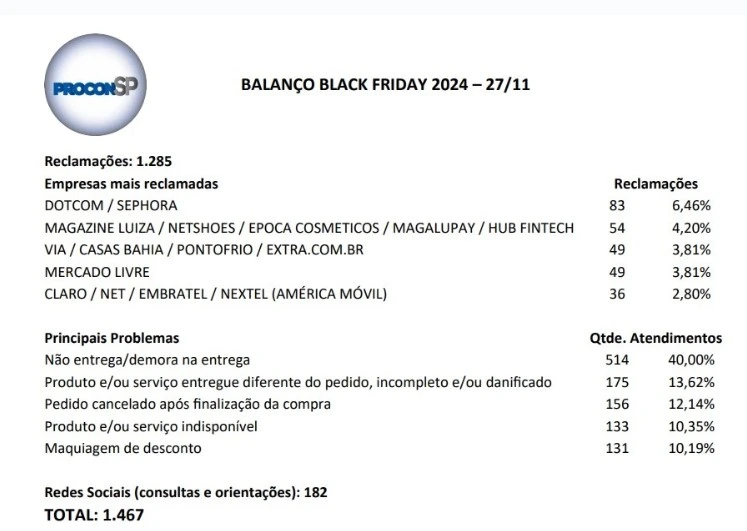
To guide both consumers and businesses, Leonardo Neri, a lawyer specializing in consumer law and partner at the law firm Mazzucco & Mello Advogados, lists the main rules governing promotional activities – which must remain in effect even on dates of high demand. Check them out below.
Consumer rights and responsibilities
According to Leonardo Neri, the main points are:
- Fulfill what was promised.The advertised price, payment terms, and deadlines must be honored. "Pricing errors" only justify cancellation if they are manifestly absurd and communicated immediately.
- Total transparencyIt is mandatory to inform the final price – including shipping and fees, product characteristics, delivery time and return policy before purchase.
- Genuine advertisingAvoid "fake discounts" or misleading offers. The comparison with the previous price must be real and verifiable.
- Right of withdrawalFor online purchases, the consumer can cancel within 7 days of receiving the product and receive a full refund – including shipping costs.
- Efficient delivery and after-sales service.Delays or failures must be communicated by the supplier, with options for reimbursement or replacement. The customer service department needs to act quickly.
- Exchanges and warrantyDefective products are entitled to a minimum period of 30 to 90 days for repair, replacement, or refund – as stipulated in... Consumer Protection Code (CDC).
- Avoid abusive practicesAmong other things, tied selling, unjustified limitations on payment methods, and artificially increasing prices before a promotion to simulate a large discount are prohibited.
“We believe that the best Black Friday strategy is to fully deliver on promises, act transparently, and maintain fast and effective customer service. This reduces fines from consumer protection agencies and strengthens the brand's reputation,” points out Leonardo Neri.
Ethical and responsible consumption
In other words, the importance of respecting these rights is not limited to legal compliance, but also to building a relationship of trust with customers. In a scenario where aggressive promotions and tempting offers can lead to deceptive business practices, it is crucial that companies ensure transparency in information regarding prices, delivery times, and exchange and return policies.
Failure to comply with consumer protection regulations can result in legal sanctions and damage to brand reputation, as well as harm the shopping experience and customer satisfaction. Therefore, by promoting an ethical and responsible shopping environment, retailers not only protect their consumers but also strengthen their market position.
Why is this care necessary?
The high number of complaints to Procon-SP (São Paulo's consumer protection agency) during the 2024 event serves as a warning: offers are not exempt from consumer protection laws simply because they are on sale. For retailers, this means that Black Friday campaigns require both logistical planning (inventory, delivery, customer service) and clear and reliable communication.
For the consumer, this means that "promotions" should not be synonymous with carelessness – and that keeping records of the purchase (screenshots of the offer, conditions, delivery time) can make a difference in case of a dispute. In the meantime, it is essential that the consumer adopts some practices that ensure a safe and conscious shopping experience.
The first tip is to start your research in advance. Tracking the price history of the desired product is essential to identify whether the advertised "discount" is legitimate or just a smokescreen. This prior analysis can prevent frustration and unnecessary expenses. Secondly, it's crucial to check the final price of the product. When calculating the total cost, you need to add any shipping costs, fees, and consider the delivery time. Comparing these offers with prices outside the event can reveal whether the promotion is truly advantageous.
It is important to carefully read the exchange, return, and warranty conditions before making a purchase. This information is crucial to avoid unpleasant surprises after the transaction. It is also advisable to keep evidence of the offer, such as screenshots of the webpage, confirmation emails, and proof of payment. These records can be valuable in case of discrepancies or problems with the purchase.
Right of withdrawal
Consumers should be aware of their right of withdrawal. For online purchases, it is possible to cancel the purchase within 7 days of receiving the product, as stipulated by the Consumer Protection Code.
Finally, if problems arise such as delays, cancellations, or receiving products different from what was ordered, it is important to file a complaint. By following these guidelines, consumers can take advantage of Black Friday promotions.y In a safer and more conscious way, ensuring that purchases are truly advantageous.
Procon-SP Survey
The São Paulo Consumer Protection Agency (Procon-SP) has launched a survey on its website to understand how consumers in São Paulo behave during Black Friday. The survey, called "Keeping an Eye on Black Friday: What Paulistas Think About Prices and Promotions," aims to identify habits, perceptions, and feelings that influence consumption during this period. The idea is to contribute to improving guidelines and public policies focused on consumer protection.
The survey is open to the general public and contains 26 quick questions. The questions address topics such as monitoring offers and trust in discounts. It also covers emotions and influencers in purchasing decisions. Furthermore, it addresses issues related to reactions to "today only" type advertisements, "interest-free" payments, and the relationship between price, quality, and status.
The questionnaire is available on the website. www.procon.sp.gov.br.