
Battery Auctions of 2026: Brazil Advances to Decisive Stage of Contracting Storage Systems
The first Brazilian auctions dedicated to contracting battery energy storage systems are advancing to a decisive stage. With 6,091 registered projects, totaling 296,807 MW of power, the auctions scheduled for December 2026 demonstrate market interest and inaugurate a new investment front in Brazilian electrical infrastructure.
The contracting occurs within a context of expansion of variable renewable energy sources and a growing need for flexibility and operational security of the National Interconnected System (SIN). Storage systems allow for the conservation of energy for later use, helping to manage fluctuations between generation and demand and offering greater flexibility to the operation of the grid.
In this scenario, two Capacity Reserve Auctions in the form of power are planned: the LRCAP National Storage, on December 2nd, and the LRCAP Storage, on December 4th, 2026. The winners will sign 15-year contracts, with supply scheduled to begin on August 1st, 2028.
What has already happened and what stage are we at?
The guidelines for the bidding processes were established by Normative Ordinance No. 136/2026 of the Ministry of Mines and Energy (MME), which structured two distinct products. The first is aimed at systems that meet the applicable nationalization requirements, while the second will be open to other eligible projects.
Between June and July, interested parties completed the technical registration of their projects with the Energy Research Company (EPE). By the end of the period, 6,091 projects had been registered, totaling 296,807 MW — a volume that demonstrates the scale of interest generated by the new energy storage market.
This number, however, does not correspond to the total number of projects already qualified for the auctions. Currently, EPE is technically analyzing the registered projects, and only those approved will be able to proceed to registration in the bidding processes.
In parallel, the National Electric Energy Agency (ANEEL) is conducting Public Consultations No. 22/2026 and No. 23/2026 on the draft notices, contracts, and other auction documents. On September 1st, a public hearing was also held to discuss the proposals with interested parties.
There is an important distinction between the current stage and the qualification of the winning companies. EPE analyzes the technical suitability of the projects before the auction. The legal, fiscal, economic-financial, and technical qualification of the selected bidders will occur after the bidding, due to the inversion of phases foreseen for the bidding processes.
The market is therefore in a transitional phase between the high level of interest shown in registration and the definition of the projects that will actually be in a position to compete for contracts.
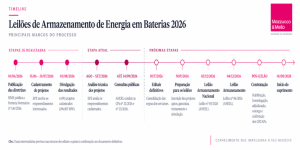
The main milestones already achieved and the next steps of the bidding processes are consolidated in Annex I – Timeline of Storage Auctions 2026.
Drainage capacity and connectivity will be determining factors.
One of the main filters for the projects should be the remaining capacity of the SIN (National Interconnected System) for flow.
In the case of batteries, the analysis has a relevant peculiarity: it must consider not only the grid's capacity to receive the energy discharged by the system, but also the conditions necessary for its charging. Restrictions in either of these directions can limit the available capacity at certain connection points and, consequently, affect the viability of the projects.
The location of ventures therefore becomes an integral part of the agents' competitive strategy. Price and technology, in isolation, will not be enough: network access, connectivity capacity, and the systemic conditions of the chosen location can be decisive factors in a project's progress.
This aspect gains particular importance given the high number of registered projects. The difference between the initially presented universe and the truly competitive ventures should result precisely from the combination of technical, locational, regulatory, and economic filters.
Long-term contracts require attention to project structuring.
The winning projects will enter into Capacity Reserve Power Contracts (CRCAPs) with a duration of 15 years and remuneration based on annual fixed revenue.
The projects will be subject to specific requirements regarding power, availability, efficiency, recharging, and operation, which must be considered from the technical and economic-financial structuring of the ventures. The main technical and contractual parameters of the tenders are summarized in Annex II.

The duration of the contracts brings revenue predictability, but also requires an economic and financial structure capable of considering the entire life cycle of the asset. In addition to the initial investment, the proposal must incorporate the costs of operation and maintenance, network connection and use, insurance, guarantees, and other obligations related to the project.
The very nature of the technology adds a relevant variable: battery degradation over time. The need to replace modules or equipment to maintain contracted performance levels should be considered from the initial design phase, impacting supply contracts, performance guarantees, financing, and risk allocation.
Domestic content can boost a new supply chain.
The LRCAP National Storage program adds an industrial dimension to the model. Projects must comply with nationalization requirements associated with the criteria of the National Bank for Economic and Social Development (BNDES).
This does not necessarily mean that all system components must be entirely produced in Brazil. Compliance will depend on applicable accreditation and verification rules, which makes the early structuring of the supply chain relevant.
For manufacturers, integrators, and developers, the model can stimulate industrial partnerships, the procurement of domestic components, the installation of production capacity, and the signing of long-term supply contracts. The supply chain, therefore, ceases to be merely a commercial issue and becomes an integral part of the regulatory and financial strategy of the projects.
The next steps
In the coming months, ANEEL (Brazilian Electricity Regulatory Agency) is expected to consolidate the contributions received in the public consultations and publish the final versions of the bidding documents and contracts, while EPE (Energy Research Company) will continue with the technical analysis of the registered projects.
Projects deemed eligible may then proceed to registration for the tenders and fulfillment of the requirements necessary for participation. After the auctions, the qualification of the selected bidders will begin, followed by the steps necessary for contracting.
From there, the challenge shifts from competing for contracts to implementing the projects. Financing, equipment acquisition, engineering and supply contracts, licensing, connectivity, testing, and certifications must be coordinated to ensure the systems are ready to begin supplying the system.
The detailed dates have been concentrated in Annex I, preventing the succession of procedural milestones from compromising the fluidity of the analysis.
A new frontier for Brazilian electrical infrastructure.
The registration of nearly 300 GW reveals that energy storage is already generating significant interest among industry players. The question now will be to identify which projects will be able to transform this initial interest into technically viable, financially structured, and effectively contracted ventures.
For developers and investors, location, connectivity, corporate and financial structure, and proper risk allocation are gaining importance. For manufacturers and integrators, especially in the auction of national content, opportunities arise related to the formation of a new supply chain. For banks, funds, and other financiers, long-term contracts can contribute to the development of a new class of infrastructure assets.
In this sense, the December auctions represent more than just the contracting of additional capacity for the electrical system. They constitute a first step towards the formation of a large-scale Brazilian energy storage market, with potential effects on investments, financing, industry, and the operation of the National Interconnected System (SIN).
The consolidation of this market will depend not only on the outcome of the initial tenders, but also on the ability to transform the regulatory and operational lessons learned from this experience into a stable framework for new projects. Energy storage is thus poised to occupy an increasingly important role in the modernization and security of Brazil's electrical infrastructure.