
40-hour work week
On November 12, 2026, Minister Flávio Dino partially granted the precautionary measures in ADIs 8.041 (CNC) and 8.042 (CNI), filed against Constitutional Amendment No. 141/2026, known as the "Amendment to End the 6x1 Shift Schedule". The reduction of the workday and the second weekly rest period were maintained; the decision adjusted deadlines and established transition criteria.
ADI 8.041 was filed on November 3, 2026. On November 5, the rapporteur maintained the Amendment's schedule and scheduled a conciliation hearing, held on November 10 with the Union, Congress, the Attorney General's Office, 10 employers' confederations, and 11 labor unions. Several points of the decision incorporate convergences recorded at that hearing.
As a premise, the decision states that, at this stage, there is no violation of the entrenched clause (article 60, § 4, of the Federal Constitution). The control exercised is limited to correcting contradictions and gaps in the Amendment, in favor of legal certainty.
| Maintained | Adjusted |
| 42 hours per week and 2 rest days starting on 12/16/2026 | Distribution of the 42 hours without a collective agreement. |
| 40 hours per week starting 12/16/2027 | Deadline for reviewing collective agreements |
| No reduction in wages, including minimum wages. | Rules for compensating rest periods |
| Application to existing contracts | Term of administrative contracts and the regime of state-owned enterprises. |
From 6x1 to 5x2
Constitutional Amendment No. 141/2026 amended Article 7, XIII and XV, of the Constitution: the normal working hours are now 8 hours per day and 40 hours per week, with a paid weekly rest period of 2 days. The reduction is progressive and applies to contracts in force, without reduction in salary, including minimum wages (Article 2 of the Amendment).
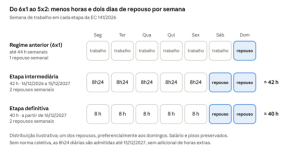
Work week in three stages
Timeline
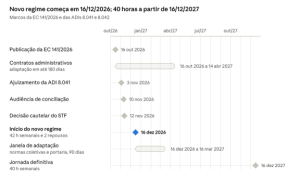
Schedule of EC 141/2026 and ADIs 8,041 and 8,042 · 8 marks
The final terms of the 90-day window and the 180-day period for administrative contracts were calculated in calendar days for reference.
42-hour work week without collective agreement
Dividing 42 hours by 5 days results in 8 hours and 24 minutes per day, exceeding the constitutional limit of 8 hours. Article 7 of the Amendment allows collective bargaining to extend the daily work hours at this stage, but did not address the absence of an agreement. The decision filled this gap, maintaining collective bargaining as the preferred method (Article 7, XXVI, of the Federal Constitution and General Repercussion Theme 1,046).
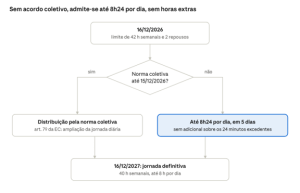
Distribution of the 42 hours in the intermediate stage.
The solution avoids two consequences rejected by the decision: the automatic anticipation of the 40 hours and the payment of overtime for the 24 daily minutes.
Collective agreements: the 90-day window
Article 3 of the Amendment removes the effect of collective bargaining agreements regarding working hours and rest periods that are incompatible with the new regime. The decision recognized that these agreements result from reciprocal concessions and that the removal of some clauses could affect the overall balance.
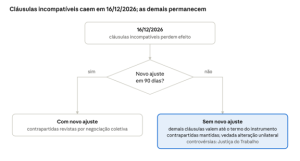
Effects of Constitutional Amendment 141/2026 on existing collective bargaining agreements.
Neither collective agreements nor individual contracts prevent the application of the new regime. The 90-day window, starting on December 16, 2026, serves only to rebalance the negotiated counterparties.
Compensation for rest periods: limits
The decision removed the weekly and monthly restrictions stipulated in Article 7, § 2 of the Federal Constitution, but preserved the right to the two rest periods as inalienable.
Paragraph 2 allows for compensatory arrangements "exceptionally" through collective bargaining agreements. The decision understood that the exceptionality refers to the manner in which rest periods are enjoyed, and not to the nature of the activity, citing commerce, agriculture, tourism, and maritime work as examples of sectors with seasonal demand or continuous operation.
| Allowed | Forbidden |
| To define, through agreement or collective bargaining, when rest periods will be taken. | Eliminate either of the two weekly rest days. |
| Deferring enjoyment, without weekly or monthly limits. | Exceeding 42 hours per week (40 hours from 12/16/2027) |
| Adopting compensatory regimes in any economic activity. | Compensation without collective agreement after the first 90 days |
| Apply a subsidiary Joint Ordinance within the first 90 days if negotiations fail. | Using compensation to reduce the right to working hours or rest periods. |
Other points of the decision
Salary neutrality. Compensation and minimum wages must be preserved. This preservation, in itself, does not justify requests for salary equalization for workers hired under different conditions, except in cases provided for by law.
Different regimes by sector. Section 3 of Article 7 of the Brazilian Constitution stipulates that the law "may" establish differentiated regimes. The decision interpreted this expression as a duty to legislate and appealed to Congress to do so within 180 days. These laws may modulate the manner of enjoyment, but cannot eliminate the workday or the two rest periods.
Micro-enterprises and small businesses. In accordance with articles 170, IX, and 179 of the Federal Constitution, article 5 of the Amendment now imposes a duty of differentiated treatment. There was a new appeal to the legislature, with a deadline of 180 days, prohibiting the reduction of working hours and rest periods. The decision records the enactment of Complementary Law No. 238/2026.
Administrative contracts. The one-year deadline stipulated in Article 9 was deemed disproportionate and reduced to 180 days, starting from the publication of the Amendment. For tenders in progress at the time of promulgation, the deadline runs from the signing of the contract, while preserving the restoration of the economic and financial balance.
Employees of state-owned companies. Article 8 exempts employees with higher education degrees and remuneration of at least 2.5 times the RGPS ceiling from working hour control, but excluded public employees. Based on Article 173, § 1, II, of the Federal Constitution, the decision extended this regime to state-owned companies operating in a competitive environment.
Nature of the decision
The decision is made by a single individual and has legal effect. erga omnes and immediate effectiveness. It was submitted to a plenary referendum (article 10 of Law No. 9,868/1999), which may confirm, modify, or revoke it. The merits of the actions remain pending.
Article written by: Rafael Mello.