
Supreme Court Demands Accountability from Those Who Litigate Without Financial Risk
ADC 80: New criteria for free legal aid throughout the Judiciary.
On September 3, 2026, the Plenary of the Supreme Federal Court concluded the judgment of ADC 80 and redesigned the criteria for granting free legal aid to individuals. The RGPS ceiling parameter (40%), introduced by the Labor Reform (Law 13.467/2017), was declared unconstitutional and replaced, until Congress legislates, by a relative presumption of insufficient resources for those who receive up to R$ 5,000 per month. Above this amount, the granting of free legal aid depends on concrete proof. Summary 463, I, of the TST — which admitted simple self-declaration — was also declared unconstitutional. The rule applies to all branches of the Judiciary, except for the Special Courts, and only covers actions filed after the publication of the judgment minutes.
The portrait that motivated the decision
The lawsuit was filed by the National Confederation of the Financial System (Consif), which requested confirmation of the constitutionality of paragraphs 3 and 4 of article 790 of the CLT (Consolidation of Labor Laws) in light of the consolidated practice in Labor Courts of granting the benefit based solely on a declaration of indigence. The numbers presented in the case are telling: in 2025, 98.71% of labor lawsuits filed against banks were accompanied by a request for free legal aid, and the benefit was granted in 99.91% of cases, even though the average remuneration of the category is much higher than the old legal ceiling. Former employees with salaries between R$26,000 and R$84,000 were even cited as having benefited solely from self-declaration.
This scenario revealed a structural asymmetry: those who resort to the courts without any financial risk have little to lose; those who defend themselves commit time and resources, even if their claim is unsuccessful. Free legal aid, conceived as a guarantee of access for those who cannot afford the costs of the process, had become an almost automatic rule.
What the Supreme Federal Court decided
The dissenting opinion, presented by Justice Gilmar Mendes, who drafted the judgment, prevailed, supported by Justices Flávio Dino, Cristiano Zanin, André Mendonça, Nunes Marques, Alexandre de Moraes, Dias Toffoli, and Luiz Fux. Justices Edson Fachin, the rapporteur, and Cármen Lúcia were in the minority, as they argued for maintaining the 40% criterion for the social security ceiling and upholding the validity of self-declaration as evidence, as per Article 99, § 3, of the Code of Civil Procedure.
For most, the percentage criterion of the CLT (Consolidation of Labor Laws) was outdated and, moreover, the coexistence of stricter rules in Labor Courts with the unrestricted acceptance of self-declaration in other branches created unequal treatment between people in similar economic situations. The Court recognized a partial omission in paragraphs 3 and 4 of article 790 and, to remedy it, standardized the parameter throughout the Judiciary, taking as a reference the income tax exemption bracket (R$ 5,000, according to Law 15.270/2025). The thesis also incorporated considerations from Minister Zanin, regarding the possibility of rejection due to incompatible assets, and from Minister Dino, regarding the extension of the presumption to those assisted by the Public Defender's Office and the exclusion of Special Courts.
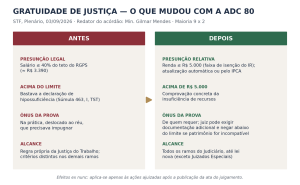
The established thesis
- Unconstitutionality of the expression “40% of the maximum limit of RGPS benefits” (article 790, § 3, of the CLT).
- Until new legislation is enacted, there is a relative presumption of insufficient resources for those receiving up to R$ 5,000; updates to the income tax exemption bracket are automatically reflected in the parameter and, in the absence of annual updates, the value is adjusted by the IPCA (Brazilian inflation index).
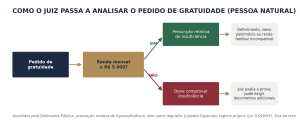
- Above R$ 5,000, the applicant must concretely demonstrate insufficient resources.
- Even if below the threshold, the judge may deny the benefit if they find assets or family income that are inconsistent with the presumption.
- The burden of proving income or insufficiency rests with the applicant; the judge may require additional documentation.
- The rules apply to all branches of the Judiciary, not just the Labor Courts, until legislative adjustments are made.
- Unconstitutionality of Precedent 463, I, of the TST (Superior Labor Court).
- Ex nunc effects: starting from the publication of the minutes of the judgment on the merits, only affecting lawsuits filed after that date.
- The presumption of indigence extends to those assisted by the Public Defender's Office; the Small Claims Courts are excluded from this argument.
R$ 5 thousand is not a ceiling: it's a presumptive parameter.
It is important to clarify the scope of the decision. The value of R$ 5,000 does not prevent the granting of free legal aid to those who earn more: it only defines who is, in principle, exempt from producing evidence. Above this threshold, the benefit remains possible, but depends on concrete demonstration—pay slip, bank statements, income tax return, proof of expenses—that the party cannot afford the costs without jeopardizing their own livelihood. Below this threshold, the presumption is relative and can be overturned when the records reveal incompatible assets or family income, always with an analysis of the circumstances of the specific case. The judgment concerned natural persons: for legal entities, the requirement of conclusive demonstration of the impossibility of bearing the costs of the proceedings remains (Article 790, § 4, of the CLT; STJ Precedent 481).
The decision also establishes an update mechanism: changes to the income tax exemption bracket automatically affect the criterion, and if there is no annual update, the value will be corrected by the IPCA (Brazilian inflation index). This avoids the lag that eroded the 2017 parameter.
Why change deserves to be celebrated.
Legal aid serves an essential function by protecting those who cannot afford the costs of litigation, and ADC 80 does not eliminate it for those who genuinely need it. The difference lies in the criteria applied to those with greater economic capacity and who can therefore demonstrate their financial situation. As the winning vote argued, the model directs the benefit to those who truly need it and discourages frivolous lawsuits, without closing the doors of the Judiciary.
The result is a rebalancing of a previously asymmetrical relationship. Access to justice remains a right; the responsibility for the decision to litigate becomes a more consistent part of the system.
What changes for companies and legal departments?
The modulation of effects is the starting point: the new rules only apply to lawsuits filed after the publication of the minutes of the judgment on the merits, so that ongoing lawsuits remain under the previous regime. It is recommended to internally establish the date of publication of the minutes as the benchmark for sorting the portfolio, separating lawsuits filed before and after this date. For new claims, we recommend:
- Systematic analysis of requests for free legal aid. The defense must verify the declared income, compare it with employment records (last salary, severance pay, health plans and benefits) and challenge it in a reasoned manner whenever the parameter is exceeded or there are indications of incompatible assets. The challenge must be made in the defense itself; in Labor Courts, the decision that considers the request in the cognizance phase is interlocutory and, as a rule, is only re-litigated in an ordinary appeal (TST Precedent 214).
- Requirement for supplementary documentation. Above R$ 5,000, it is necessary to request that the court order the submission of proof of income, bank statements, and income tax returns, remembering that the burden of proof lies with the applicant. Before rejecting the request, however, the court must provide an opportunity to prove the prerequisites (Article 99, § 2, of the CPC), which makes an individualized and documented challenge decisive, not a generic one.
- Pay attention to the rules regarding liability for costs. The denial of free legal aid brings back into question the costs, expert witness fees (article 790-B of the CLT), attorney's fees (article 791-A of the CLT), and costs due in case of dismissal for unjustified absence (article 844, § 2, of the CLT). For the beneficiary of free legal aid, the enforceability of these fees is governed by the decision of the Supreme Federal Court in ADI 5.766; if the benefit is revoked, the responsibility is full—which tends to influence both the decision to file a lawsuit and the scope of the claims.
- Caution is advised regarding constitutional claims. As suggested by Minister Dino, a claim to the Supreme Federal Court (STF) is appropriate when the decision directly contradicts the established legal principle, but should not, as a rule, serve to re-examine facts and evidence regarding the financial situation of each beneficiary.
- Monitoring of developments. Appeals for clarification are still possible after the publication of the judgment. In the Legislative branch, Bill 2239/2022 — approved by the Senate on June 30, 2026, in the form of a substitute bill, with a presumption of free services for net income of up to two minimum wages calculated by the average of the three months prior to the request, and returned to the Chamber of Deputies — could replace the provisional parameter established by the Supreme Federal Court.
This information is for informational purposes only and does not constitute legal advice. For guidance on specific cases, please contact our team.
- “"Free legal aid was conceived as a guarantee of access for those who cannot afford the costs of the legal process. It had become an almost automatic rule."”
- “R$ 5 thousand is not a ceiling. It is a presumptive parameter: above that amount, the benefit remains possible, provided it is demonstrated.”
- “"Those who take legal action without any financial risk have little to lose; those who defend themselves commit time and resources, even if their claim is unsuccessful."”
- “"Access to justice remains a right. The responsibility for the decision to litigate is now integrated into the system in a more consistent way."”